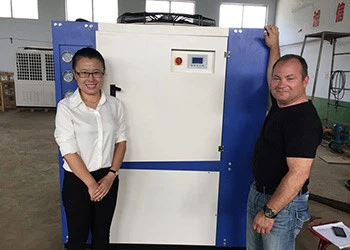


Water Cooled Scroll Chiller
Why Choose Us?
Best After-Sales Service
We have a large number of professional after-sales service teams. Should you have any inquiries after receiving your shipment, feel free to reach out to us anytime.
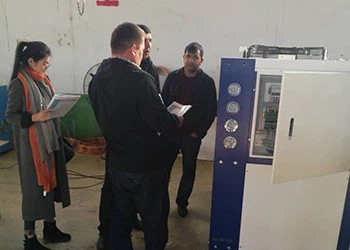
Real Factory
Our company has more than 5,000 square meters of production plants and more than 200 employees engaged in product production, research and development and after-sales service
Rich Experience
We have 17 years of manufacturing experience and have provided professional solutions to many customers.
OEM & ODM Capabilities
We offer customized services, tailoring products to your specific requirements.
What is Water Cooled Scroll Chiller?
A water-cooled scroll chiller is a type of refrigeration system used to cool large buildings, such as office buildings, schools, and hospitals. It works by using water to transfer heat from the refrigerant to the outside environment. Refrigerant refrigeration cycle: A refrigerant, typically R-134a or R-407C, is compressed in the compressor and then cooled in the condenser. The refrigerant then expands in the evaporator, where it absorbs heat from the building and becomes a low-pressure, low-temperature gas. Water loop: The refrigerant then passes through the water-cooled condenser, where it is cooled by water that is circulated through the system by a pump. The water removes heat from the refrigerant, which is then dissipated into the outside air.


Efficient heat removal
Water cooled scroll chillers excel in transferring heat from process water to other areas, safeguarding your equipment, applications, and end products. By cooling water to precise temperatures, these chillers ensure uninterrupted industrial processes and effectively prevent costly downtime and production delays.
Enhanced energy efficiency
Compared to other cooling methods, water-cooled chillers are more energy-efficient. The reason lies in water's enhanced ability to conduct heat. It effectively absorbs and removes heat from the chilled water circuit more rapidly and with reduced energy use compared to air-based cooling. This efficiency in heat transfer means the chiller's compressor has to do less work, resulting in decreased energy usage.
Ease of installation
Modern water cooled scroll chiller models are designed to be compact to facilitate easier installation even in space-constrained areas. They don't emit heat into their surroundings, allowing installation in areas with poor ventilation. This design flexibility means businesses don't need to make significant infrastructural changes to accommodate a new chiller.
Dependable performance
Top-quality water cooled scroll chillers offer a wide range of cooling capacities suitable for various industrial applications. Water chiller manufacturers can customize these chillers for specific working conditions, like using stainless steel heat exchangers for processes involving deionized water in medical or food industries. This adaptability ensures reliable performance across different industrial needs.
Scalability for large-scale operations
While water cooled scroll chillers suit small to medium-scale cooling needs, current models offer modular designs that can be expanded for larger operations. This scalability is particularly beneficial for businesses with growing or evolving cooling requirements, eliminating the need to invest in bigger chillers as the business expands.
What are the Core Parts of a Water Cooled Scroll Chiller?
Water-cooled scroll chillers, just like other conventional chillers, have four primary segments: evaporator, condenser, compressor, and refrigerant circuit.
Compressor
Most chillers have a hermetic type scroll compressor. The compressor is usually axially and radially inclined in a scroll design. Most significantly, the entire compressor parts are dynamically and statically balanced. Besides, the compressors do have a large internal volume to provide a better liquid tolerance. And to cut off vibration to other chiller types, you should install the compressor on isolator pads.
Evaporator
Every chiller model has a distinct type of evaporator. The evaporator consists of tubes where the refrigerant flows while the chilled liquid flows through the shell. The evaporator tubes and shells are compact and efficient at withstanding pressure. Most importantly, manufacturers effectively design the evaporator per the Underwriters Laboratories (U.L.) standards. Moreover, the evaporator heat exchanger material comprises parallel-type stainless steel 304 plates.
Water-cooled Condensers
The predominant condensers are a typical shell and tube type with retractable water heads. Water flows through the tubes while the refrigerant passes through the circuits on the sides of shells. Both the shells and tubes have a design capable of withstanding the liquid and refrigerant working pressure up to certain limits.
Refrigerant Circuit
A chiller may have solitary, double, or multiple refrigerant circuits depending on the model and type. The entire pipping of the circuit is copper with brazed joints. The circuit's liquid line comprises sight glass with moisture indicator, shutoff valve, thermal expansion valve, and solenoid valve, amongst others.
Cooling Tower
A water-cooled chiller has a compulsory cooling tower that expels heat from the water discharged from the condenser. The cooled water gets channeled back into the system for re-cooling the system or otherwise released into the environment.
Control/ Power Panel
Every unit of the water chiller has a control panel with a microprocessor that regulates the equipment's functioning and operation. The standard controls include automatic pump-down, unit alarm controls, mechanical, systematic optimization. Most importantly, the automatic software programming for an automatic unit shall get installed in control to avert possible system failure. The power panel contains the control platform for power sections for every electrical part of the system.
What are the Features of Water-Cooled Scroll Chillers?
● Flexible design; you can select a water-cooled scroll chiller then optimize it to meet your specific job application.
● Luckily customization of the chiller is quick and straightforward when done by professional manufacturers.
● Highly efficient compressor technology; if you properly select a hermetic scroll compressor, you will be destined for excellent part-load efficiency with your equipment.
● Control technology; the chiller comes with fully installed onboard electronics that enable you to promptly and efficiently run the machine.
● Above all, the controls perform smooth controls, self-diagnostic tests, and troubleshooting.
● Quality Refrigerant; the scroll chillers use a highly efficient refrigerant with no ozone depletion and phase-out schedule.
● Standards and qualifications; an entirely manufactured water cooled scroll chiller must conform to the pre-set standards and certifications.
How Does Water Cooled Scroll Chiller Operate?
The operation begins with the refrigerant liquid at low pressure entering the evaporator tubes. In the evaporator, the liquid gets super-heated and evaporated by the heat energy derived from the chilled liquid on transit through the evaporator shells. Subsequently, a low-pressure vapor gains entry into the scroll compressors, whereby both the pressure and super-heat rise. After that, the resultant high-pressure vapor passes via the condenser. Meanwhile, the condenser water passing through the tube absorbs the heat from the steam. The condenser water then exits to the cooling tower. After that, the completely condensed and subcooled liquid exits the condenser then enters the expansion valve. Here, the pressure continuously reduces, and further cooling occurs. Finally, the now low-pressure refrigerant liquid goes back to the evaporator, and the process repeats itself.
What are the Technical Specifications of Water-Cooled Scroll Chillers?
The scroll chiller's technical specifications refer to the threshold that every chiller should certify according to pre-outlined guidelines and designs.
Some of the predominant technical specifications of the scroll chiller include:
● Cooling capacity
● Compressor input power
● Integrated part-load value (IPLV)
● Energy efficiency ratio
● Operating weight(lbs)
● Sound pressure (dBA)
● Machine dimension (height, width, and length), amongst others.
Most importantly, you need to note that every chiller unit has its distinct technical specifications. Therefore, for clarity, you need to always refer to more details from the technical documents.
The Inner Workings of a Water Cooled Scroll Chiller
Water scroll chillers operate on two main circuits: the refrigeration loop and the chilled water loop. The refrigeration circuit is responsible for providing cooling, while the latter acts as a distribution system for cold water.
Compression
The refrigerant in chillers starts in a low-pressure vapor phase at around the same temperature as the ambient air. During the first part of the cycle, the refrigerant will move into a compressor, increasing its pressure and discharging it into the system's high-pressure side.
Expansion
During expansion, the refrigerant's pressure is lowered, further lowering its temperature. Some of the liquid will turn into vapor, allowing the rest of the refrigerant to flow back into the low-pressure side of the circuit.

Condensation
In the high-pressure side of the system, you'll find a condenser, which transfers heat from the refrigerant to the environment. For water scroll chillers, the “environment” is water acting as a heat sink. Because of the heat exchange, the refrigerant's temperature lowers, returning to a liquid state.
Evaporation
Finally, evaporation will take place in the system's low-pressure side. Generally, most water-cooled chillers use water or brine as a cooling medium. During this process, the refrigerant absorbs heat from the water, increasing its temperature until it vaporizes. Once evaporation takes place, the refrigerant returns to its low-pressure state with a similar temperature to the ambient air. It flows back into the compressor, and the loop is repeated.
How do you Conduct Water Treatment for Water Cooled Scroll Chillers?
Initially, you need to develop a chemical water treatment. By so doing, you eliminate the chances of clogging and accumulation of contaminants in the tubes’ interior shells. Such treatment eliminates scales, plugging, sludge, or even biological growth agents. Failure to remove the contaminants will result in pipework corroding, which will inevitably cause a massive equipment failure.
What is the System Water Volume for Water Cooled Scroll Chillers?
The system water volume refers to the total capacity of the water present in the evaporator, associated piping works, and air carrying products. You may wish to achieve typical and regular cooling.
That is, in applications in which the cooling load changes relatively slow. In such situations, most manufacturers recommend the following: a least system volume of about twice or thrice the flow rate (G.P.M.).
For instance, a chiller with a flow rate of 120 GPM should have a minimum system volume of 240 to 360 gallons.
If the system water volume is too low, then the chiller may run into operational hurdles.
The problems may include:
● Instant loading and unloading of compressors
● Quick cycling of the compressor
● Faulty refrigerant flow
● Unreliable motor cooling
● Generally shorter lifespan of the equipment
How Does a Water Cooled Scroll Chiller Compare to a Water-Cooled Screw Chiller?
The two types of chillers, i.e., water-cooled scroll chiller and water-cooled screw chiller, have a single significant difference in their application mode.
Firstly, scroll compressors are most prevalent with a small application, usually about under 30 tons of cooling specifications.
However, if your cooling requirements exceed the 30 tons limit, you need to evaluate a few factors.
Below are some crucial factors that would help in outlining the distinction between the two chiller types:
Scroll compressor chillers have Limited sizes: generally, the scroll compressors do not offer a considerable variation in sizes.
They only exist in limited sizes.
Nevertheless, with the continuous upgrade in technology, you may find extra dimensions, but the currently available scroll compressor is about 40HP.
It, therefore, means that if you need a large cooling capacity, you are free to choose a chiller with multiple compressors.
However, while that is a temporary relief, your choice is conditional; you should not have numerous compressors on a single circuit.
That is so because having multiple compressors on a single circuit may be a service overburden to your system.
Screw compressor chillers are suitable for large applications; currently, the available smallest screw compressors are 30HP while the largest ones range up to 400 HP.
Consequently, a screw compressor chiller is commonly a real industrial type chiller.
Scroll compressor chillers are compatible with small to medium applications; a typical scroll compressor is suitable for a small application process.
Usually whenever the sporadic time is less than 24 hours.
So typically, scroll compressors are small to medium-duty processes.
On the contrary, if you are considering operating your chiller continuously while fitting the load requirement of over 30 tons, a screw chiller would be handy.
The screw chiller types offer optimum cooling options, are serviceable, controllable, and have suitable operational ranges.
How do You Install a Water Cooled Scroll Chiller?
You can follow these steps to install water cooled scroll chiller system.
● Attach the scroll on a concrete foundation and, if need be, add some supports.
● To achieve maximum results, always install the chiller indoors.
● Ensure that the room temperature is modest, ranging from 40 F to 122 F.
● Remember to provide adequate clearance of about 3ft to the chiller’s side and back.
● Leave a sufficient overhead clearance on top of the machine.
● Mount vibration isolators on compressors and pipes if you need a noise-free application.
How do You Troubleshoot a Water Cooled Scroll Chiller?
|
Problem |
Possible causes |
|
Freeze stat |
Poor flow of water Thermostat set very low |
|
Low-pressure trip |
Low level of refrigerant No /low water Water filter clogged |
|
High-pressure trip |
Mineral build-up in the condenser Insufficient flow of water in the condenser |
|
Fuses blew |
Shorted motor |
|
Thermostat setpoint not reached |
Internal icing in the evaporator Large system load |
|
No-cooling / inadequate cooling |
Possible leak of refrigerant Varying line voltage Iced Evaporator |
Our Factory
Jinan Mgreenbelt Machinery Co., Ltd. are core enterprises of MGREENBELT compressed air system products and services chain. We specialize in producing High Pressure Oil Free Compressor, Oil Free Air Compressor, Medium Pressure Screw Air Compressor, Screw Type Air Compressor, PET High Pressure Air Compressor, and other Air Compressor.